Grade 1-3
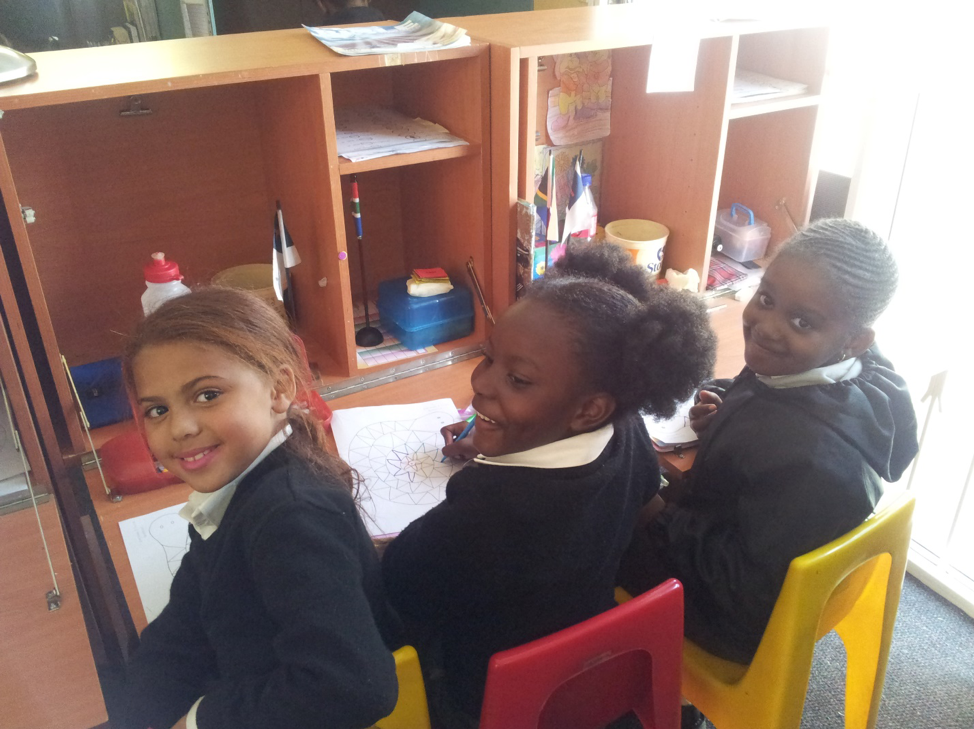
Having fun doing art together
CURRICULUM GRADES 1 – 7
Learners can be admitted at any time during an academic year. It is not necessary to wait for the following year to enroll except in the case of Grade 1 students not already enrolled in any school.
The curriculum is based upon the 5 laws of learning:
- Students must be at individual levels where they can perform
- Reasonable goals must be set
- Students must be controlled and motivated
- Learning must be measurable
- Learning must be rewarded


FOUNDATION PHASE
SUBJECTS GRADES 1 – 3 BIBLE-BASED CHARACTER BUILDING CURRICULUM
Grade 1
Students on the ACE curriculum can read extremely well and very quickly. Reading is the basis of all subjects. Failure to read well will fail to achieve in all subjects. Children who have learning difficulties also benefit from being on this program especially from Grade 1 because they do not get left behind while the rest of the class continues with new work. The students not only learn academic concepts but also learn to set goals and meet deadlines, develop critical-thinking skills, and think creatively and independently.
Before Grade 1, a reading readiness test is administered to determine reading readiness. Based upon these results determines whether the student is enrolled into Grade 1. From experience, students who pass these tests are more than ready to succeed academically which in turn affects their emotional well-being as they gain confidence and an improved self-esteem.
For the first six months, Grade 1 students are taught in a general classroom environment and all concepts are taught at the same time to all students. In the last six months of the year, the student is free to move on at their own pace. By that stage, all students are reading well. A fast student can then move on and not be held back by the rest of the class while a slower student can work until all concepts have been grasped as the curriculum is individually orientated. Not all six-year-olds wear the same size clothing and not all six-year-olds perform at the same level, grasping concepts differently.
Reading is taught from a phonics perspective initially. Once a good grasp of phonics has been put in place, sight words are introduced, and reading comes easily. Pace work is supplemented by worksheets and exercises in workbooks to provide students with alternative work exercises.
Although students work at their own pace, this pace is monitored so that students do not under-perform. Thus, should a student be underperforming both the school and parents should address this situation. The student is also not left to learn completely on his own, as he can raise a flag to get academic help when work is not understood.
TESTS
Students do not write exams on our curriculum. They do write five tests in total while completing a Pace (which is one mini-textbook with source notes). This enables the student to study concepts learned and master those concepts. The student does not fail a grade. They may fail a pace, but not a grade. Many think this approach does not prepare a student for university or post-grade 12 studies. On the contrary, it does teach the child to study. Many Successful ACE students at universities have passed Cum Laude.
Professor Jansen formerly from Bloemfontein University used to tell ACE publicly at AASC rallies (AASC at that stage was held annually at Bloemfontein University) that he would accept ACE students any day because they have a proven track record at the university for being well-rounded students who produce outstanding results.
Grades 2 and 3 Subjects
For Grade 2 and Grade 3 transfer students, diagnostic tests are administered to determine if the students have any learning gaps that need to be filled before proceeding. From a biblical perspective learning takes place line upon line, precept upon precept for the most benefit to be gained.
FOUNDATION PHASE SUBJECTS
GRADE 1 | GRADE 2 | GRADE 3 |
MATHS | MATHS | MATHS |
ENGLISH | ENGLISH | ENGLISH |
LIFE SKILLS: SCIENCE | AFRIKAANS PHONETICS | AFRIKAANS |
LIFE SKILLS: SOCIAL STUDIES | LIFE SKILLS: SOCIAL STUDIES | SOCIAL STUDIES |
|
| SCIENCE |
WORD BUILDING | LIFE SKILLS: SCIENCE | CREATIVE ARTS |
ANIMAL SCIENCE | WORD BUILDING | LITERATURE AND CREATIVE WRITING |
BIBLE READING | CREATIVE ARTS | CURSIVE |
P.E. | P.E. | P.E. |
LIFE ORIENTATION: His Servants and ministry exercises from the L.O. Manual | *ANIMAL SCIENCE | *ANIMAL SCIENCE AND BIBLE READING |
| *BIBLE READING | LIFE SKILLS |
LIFE ORIENTATION: His Servants and ministry exercises from the L.O. Manual | LIFE ORIENTATION: His Servants And ministry exercises from the L.O. Manual | LIFE ORIENTATION: His Servants and ministry exercises from the L.O. Manual |
*Expanded Curriculum
Contact Us
082 406 2350
admin@edumore.co.za
Klipriviersberg Recreation Centre, Peggy Vera Street, Kibler Park, Johannesburg.